
Earn the Best Available Stablecoin Yield on Solana, Automatically
Lending rates on Solana move all the time. Loyal routes your dollars to whichever reputable lending reserve currently pays the most, bounded by an on-chain policy, so you earn the best available rate without giving up custody. You deposit dollars, set how much goes to earning, and it works from there.

How your dollars earn with Loyal
Active and optimized: your dollars earn the most they can. Put your dollars into the optimizer and an agent continuously moves your allocation to the best-paying reserve instead of leaving it in one pool.
Bounded by a policy you approve. The routing runs through an on-chain Squads policy on your own smart account, limited to a whitelist of established Kamino reserves. It never takes custody, and you can withdraw any time.
Your stablecoins are all just dollars
USDC is reputable. PYUSD is PayPal's dollar. USDT is Tether's. USDS is a dollar too. For the purpose of earning lending yield, if holding one of these instead of another doesn't meaningfully change your risk, then they're interchangeable. They're all just dollars.
Once you accept that, a question follows: why pin your dollars to one token in one lending reserve, when a different reserve, sometimes holding a different dollar, is paying more right now? There's no good reason. Today Loyal rotates your dollars between whitelisted reserves for the stablecoin you deposited. Routing across different dollars is next on the roadmap.
Why lending rates spike (and how that's the opening)
A lending reserve has two numbers that matter: its total supply (how many dollars are deposited) and its utilization (what share of those dollars is currently borrowed). Lenders get paid out of what borrowers pay, so the rate a reserve offers depends on the balance between the two.
Picture a large lender pulling money out. Supply drops, but the borrowers don't leave, so utilization jumps. The reserve is suddenly short on capital, so it raises the APY it pays to attract fresh deposits, sometimes many times higher, before new capital flows in and it settles. Those windows are the opening. Catching them by hand is impractical. Catching them automatically is the point of Loyal.
How Loyal routes to the best rate
Moving from a worse reserve to a better one is mechanically simple. You withdraw from the first and deposit into the second, and that can happen in a single transaction. Withdraw, deposit. That's the whole motion.
Loyal automates that motion across a whitelist of reserves it trusts, not every random pool on-chain. The optimizer watches the market, sees where the rate is moving, and routes your allocation there, repeatedly, as conditions change. You don't sign each move or babysit a dashboard. None of this is a new token or a yield product you have to hold; it's automation on top of your own dollars.
Why not a big contract, a backend key, or a vault
A big custom contract
A backend private key
A manager-run vault
How the policy keeps it safe
Instead of a big contract that manages all the routing, the routing is a smart-account policy on Squads. The actions it can run are whitelisted intents: withdraw from an approved Kamino reserve and deposit into an approved one, with your smart account as the owner on both sides. Each action is harmless on its own and easy to verify.
Neither intent can move funds out of your account, which is why the yield-only operations are auto-approved by default. Loyal's backend can trigger those moves, but it never holds your key and can never step outside the whitelist. There's no private key sitting in a server waiting to be stolen, because the policy lives on-chain and the funds stay in your own smart account.
Understanding the risks
Reserve smart-contract and depeg risk
Custody is not among these risks
No liquidations, no impermanent loss
Every part is open-source
Who optimizes yield with Loyal
Treasuries holding stablecoins
DAOs and on-chain orgs
Teams managing runway
Power users and farmers
How it's built
The automation rides on Squads smart accounts, the most-deployed smart-account framework on Solana. Routing is a policy with whitelisted intents, rather than a big custom program. The lending itself happens in Kamino reserves, and the privacy layer Loyal is built on uses MagicBlock's ephemeral runtime, with the signer running in a hardware-isolated Confidential VM.
The whole stack is in the loyal-app monorepo; read how the policy, the routing, and the Kamino integration fit together.

Start earning
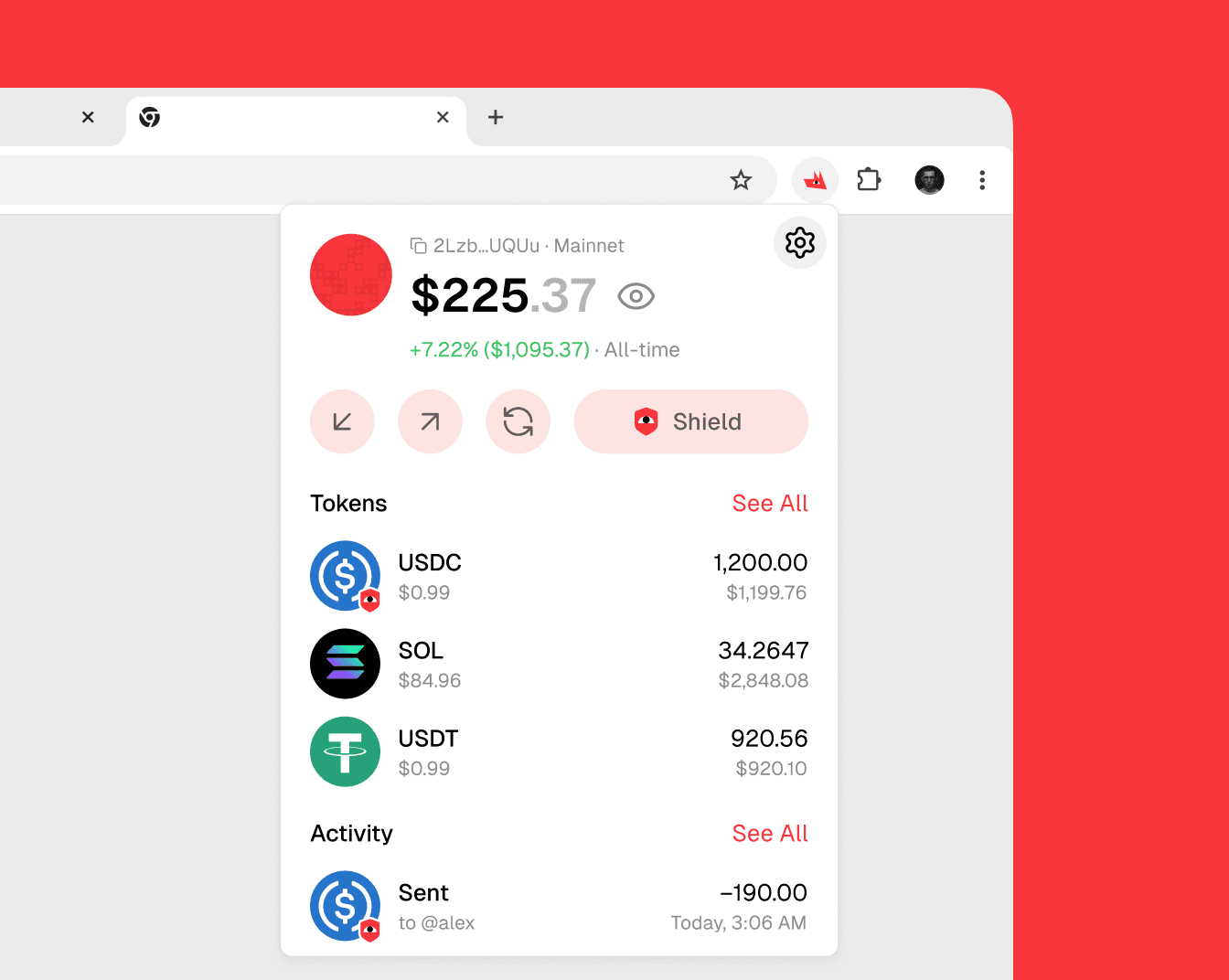
Deposit dollars, set how much goes to earning, and Loyal routes it to the best available rate from there. Loyal lives in four places, all on the same Squads-based smart account: web app, Chrome extension, Telegram mini-app, and the Android app. Stay Loyal.
Questions?
Answers.
Deposit dollars into Loyal and set how much goes to earning. Loyal routes that allocation to whichever whitelisted Kamino reserve currently pays the most for the stablecoin you deposited, and re-routes as rates move. It runs through an on-chain Squads policy, so the automation never takes custody. You can withdraw any time.
A reserve pays lenders out of what borrowers pay, balanced by its total supply and how much of it is borrowed (utilization). When a large lender withdraws but borrowing demand stays high, the reserve is short on capital, so it raises the APY it pays to attract deposits. The rate can jump well above normal for a few hours until new capital arrives and it settles. Sitting in the right reserve during those windows is where the extra yield comes from.
No. The automation runs as a policy on your Squads smart account with two whitelisted intents: withdraw from an approved Kamino reserve and deposit into an approved one, with your smart account as the owner on both sides. Loyal's backend can trigger those moves but never holds your private key and can't act outside the whitelist. Only your key can move funds out of your account.
A variable, market rate, not a fixed promise. Yield comes from Kamino's lending reserves, so the rate floats with on-chain supply and demand, and the optimizer keeps your dollars in whichever reserve is paying the most. Loyal doesn't quote magic numbers. The current rate shows in the app before you deposit, and the underlying reserve rates are public on Kamino so you can check them yourself.
The strategy is built to be low-variance. It's plain stablecoin lending, with no liquidations and no impermanent loss, because it uses neither leverage nor liquidity-provider positions. Your dollars sit in five whitelisted Kamino markets, in the stablecoin you deposited, so the residual risks are the ordinary ones any lender takes: a smart-contract issue or bad debt in a reserve, or that stablecoin losing its peg. You keep custody the entire time, and the automation can never move funds outside the whitelisted intents. The full breakdown is at askloyal.com/risks.
A managed vault takes custody and allocates for you, often with lock-ups, and it can't move fast enough to catch short rate spikes. Loyal keeps custody with you, has no lock-up, and routes faster because it monitors reserves and reacts to spikes as they happen. The trade-off is that Loyal is a newer approach; a vault is the more established set-and-forget option, better suited to institutional capital that wants to delegate.
No. You deposit dollars and set how much goes to earning. The routing runs on its own from there, moving your allocation to the best reserve as rates change. Your funds stay in your own smart account the whole time, and you can withdraw whenever you want.
Loyal Earn has no audit of its own because it has no smart contract of its own to audit. A security audit reviews on-chain program code, and Earn deploys none. Your funds sit in the Squads Smart Account program and earn in Kamino K-Lend, both audited by OtterSec. What Loyal adds is a policy: configuration stored in your Squads account and enforced by the audited Squads program, listing the two instructions the automation may call (deposit and withdraw) and the Kamino reserves it may call them on. Anyone can read it on-chain. Loyal's off-chain automation is open source and hasn't been audited, but it can only submit transactions the policy allows, so a bug in it can't move funds out of your account.